Extreme MK3
The flagship current Envy: maximum GPU headroom, full 48 Gbps HDMI 2.1, MotionAI, Geometry Correction and the most complete high-end cinema processing platform.
Flagship / 4U / 8K / 48G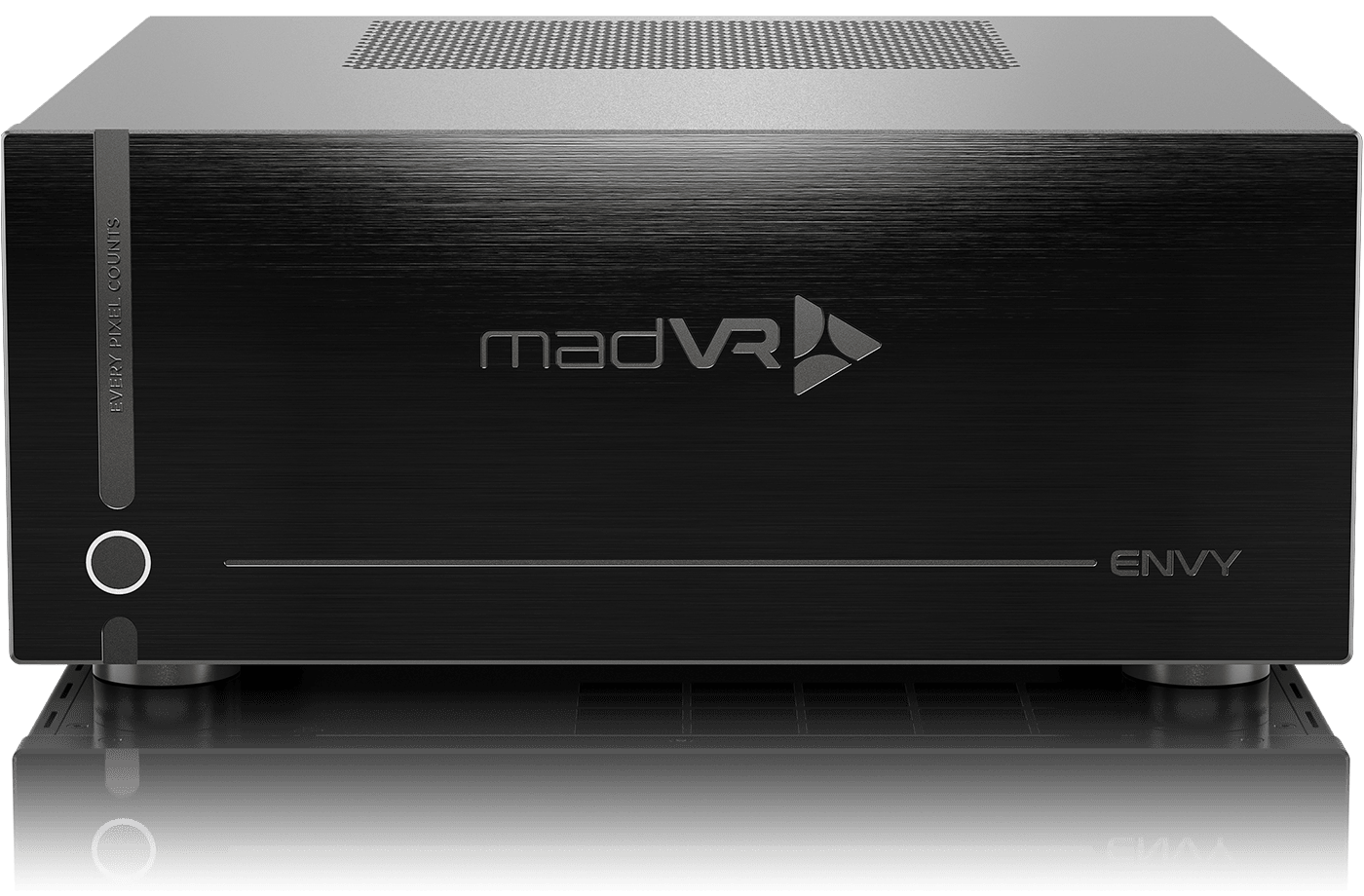
Extreme MK3 is the Envy to specify when the video processor is expected to be a reference component rather than simply a tone-mapping box. Its much more powerful GPU provides headroom for the most demanding algorithms and the features that distinguish the Extreme in complex projection installations.
The clearest examples are Geometry Correction for difficult projection geometry, curved screens or anamorphic-lens installations, and MotionAI for owners who want sophisticated motion interpolation with much finer control than a conventional projector mode.
HDR dynamic tone mapping
HDR10 content can contain highlight information far above the luminance a projection screen can reproduce. Envy analyses HDR frame by frame and maps that source range into the measured capability of the cinema. Its DTM workflow includes controls for highlight recovery, contrast recovery and shadow-detail recovery, so the objective is not simply to make the image brighter; it is to preserve intent while keeping the picture readable, dimensional and consistent.
For projection, this becomes particularly useful because the real peak luminance may be 80, 120, 150 or 250 nits depending on screen size, gain, lens, calibration and laser level. That real number matters more than the lumen figure printed on the carton.
On an Extreme-class project, DTM should be configured together with measured screen luminance, projector laser level, gamut mode and calibration. There is little value in reference processing if the processor is guessing what the screen can actually do.
Aspect ratio, scope, subtitles and masking
Envy can detect aspect ratio changes automatically and react without waiting for a manual lens-memory command. That is valuable with 2.39:1 scope screens, 16:9 screens and increasingly common 2:1 content. Non-Linear Stretch can be used when the owner prefers to reduce black bars without simply cropping the frame, while subtitle management can keep subtitles visible when they would otherwise fall into the letterbox area.
In a masked cinema, aspect detection can also become part of a broader automation strategy: projector geometry, screen masking and image placement can behave like one system rather than three unrelated products.
Extreme becomes especially compelling in cinemas where a fixed-height scope screen, masking, anamorphic optics and changing content ratios all need to behave automatically.
Maximum AI and image-processing headroom
Envy performs its image processing internally at high precision, including scaling, chroma upsampling, deinterlacing, sharpening and artifact-management tools. The value is most obvious when the source mix is inconsistent: UHD disc, streaming, broadcast material, older Blu-ray and games do not all arrive with the same quality.
AI upscaling is not a substitute for native high-resolution content, but it can make lower-resolution sources cleaner and more coherent on a very large screen. Chroma processing is also important because consumer video is commonly stored at reduced chroma resolution; reconstructing colour detail cleanly can matter when the image is several metres wide.
The Extreme MK3 uses NVIDIA 5080-class graphics hardware and is the platform madVR Labs reserves for its most advanced AI-driven features and future development.
Calibration, geometry and the complete image path
Envy supports very large 3D LUT and 1D LUT calibration workflows, allowing a professional calibrator to correct the complete signal path rather than relying only on the projector's internal CMS. This can be particularly valuable with wide-gamut RGB-laser systems, where colour accuracy, gamut mapping and grayscale tracking should be treated as part of the same system.
External processing also creates continuity when the projector is upgraded later. The calibration and signal-management philosophy can remain consistent even if the display changes.
Geometry Correction can solve image-shape problems that should not normally be attacked with crude projector keystone correction. That does not make poor projector placement acceptable, but it gives the system designer a high-quality tool when architecture, curved screens or anamorphic systems demand it.
Why choose Extreme MK3
Choose Extreme when the rest of the cinema is already at the level where the additional capabilities will be used: large Barco/Christie systems, complex scope or masking workflows, curved or architecturally constrained screens, very high-end calibration, or owners who specifically value MotionAI.
Current generation documentation.
madVR Envy product information / 2026 model comparison and specifications.
Choose the processor with the projector and screen.
Send us the projector, screen ratio, image width, source devices and the HDR or aspect-ratio problems you want to solve.