Image width
Use actual illuminated image width, not room width or screen frame width.
At the high end, lens choice can determine whether the projector can live in a hush box, a rear projection room, close to the screen or tens of metres away. Barco’s lens ecosystems are one of the most important reasons to design the optical path before construction is fixed.
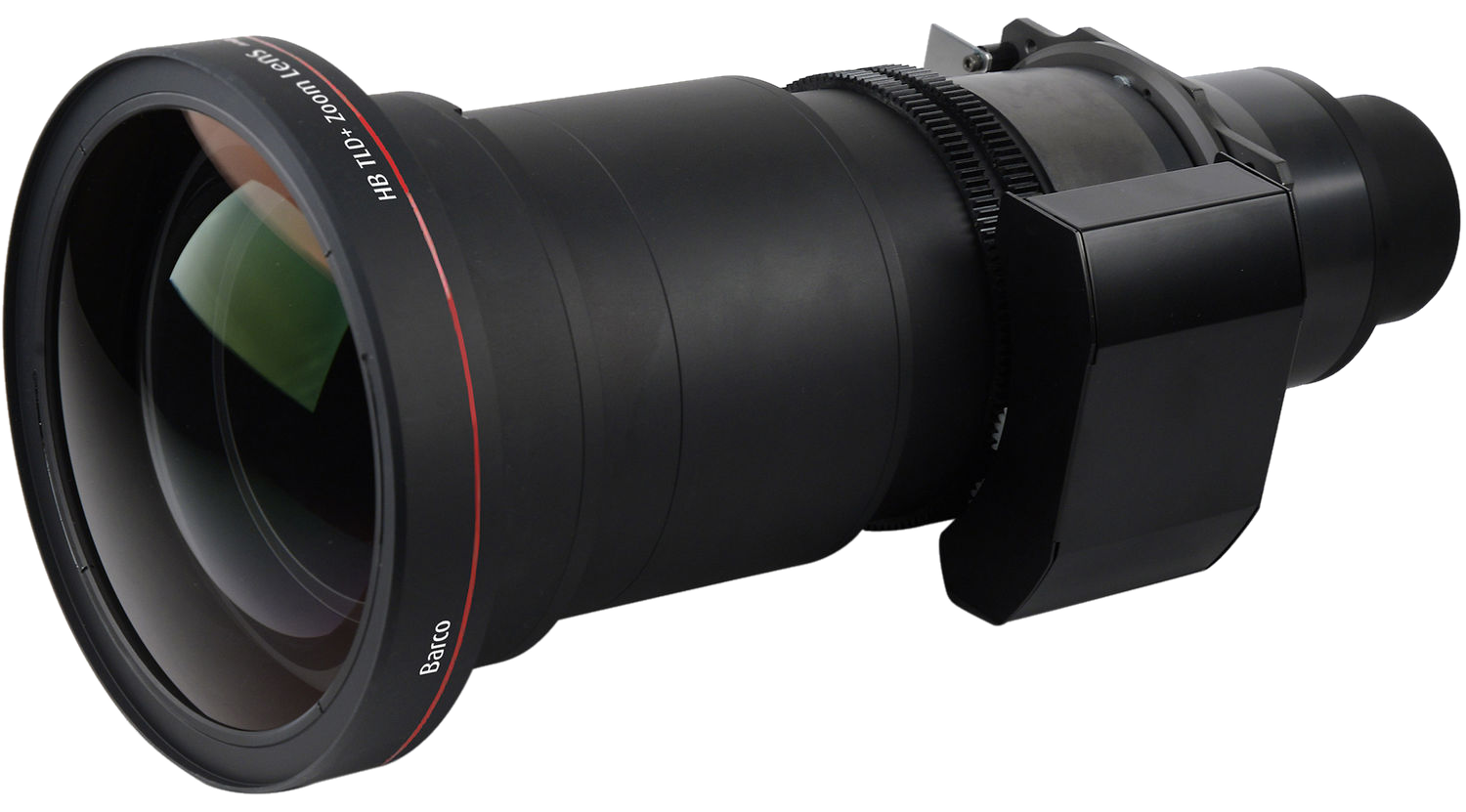
Throw ratio, image width, lens shift, lens transmission, projector position and service access should be solved together. Barco's broad lens families are one of the reasons these platforms can be engineered into difficult rooms.
Representative Barco interchangeable projection opticThrow ratio is simply projector-to-screen optical distance divided by image width. Once that ratio is known, it can be matched to the available lens families.
But throw is only the first filter. Lens shift, optical quality, projector orientation, screen format, lens adaptor, room structure and service access can all change the final choice.
Ultra-short through long throw in one chassis family.
Native-4K RGB laser with multiple lens families and adaptor options.
Type B Very High Contrast and Type C lens options; lens holder selection matters.
Very High Contrast B-lenses for the flagship large-format platform.
This is an early design aid only. Final lens selection must use Barco’s current lens calculator and project drawings.
Use actual illuminated image width, not room width or screen frame width.
Measure from the projection lens reference point to the screen plane.
Confirm lens shift, chassis size, airflow, access and any hush-box or booth constraints.
The ranges above are a planning overview. Final projector, lens, adaptor, shift and image-size selection should be checked against Barco’s current lens calculator and product documentation.
Barco I600 lens specifications · Barco Heimdall optics · Barco Freya optics · Barco Nerthus optics
Send the screen width, screen ratio, ceiling height and proposed projector position. We can work backwards to the projector and lens combination.