Radiance Pro
A mature, exceptionally configurable video processor for HDR, scaling, calibration, aspect ratio, masking and precise projection-system control.
Specialist reference processing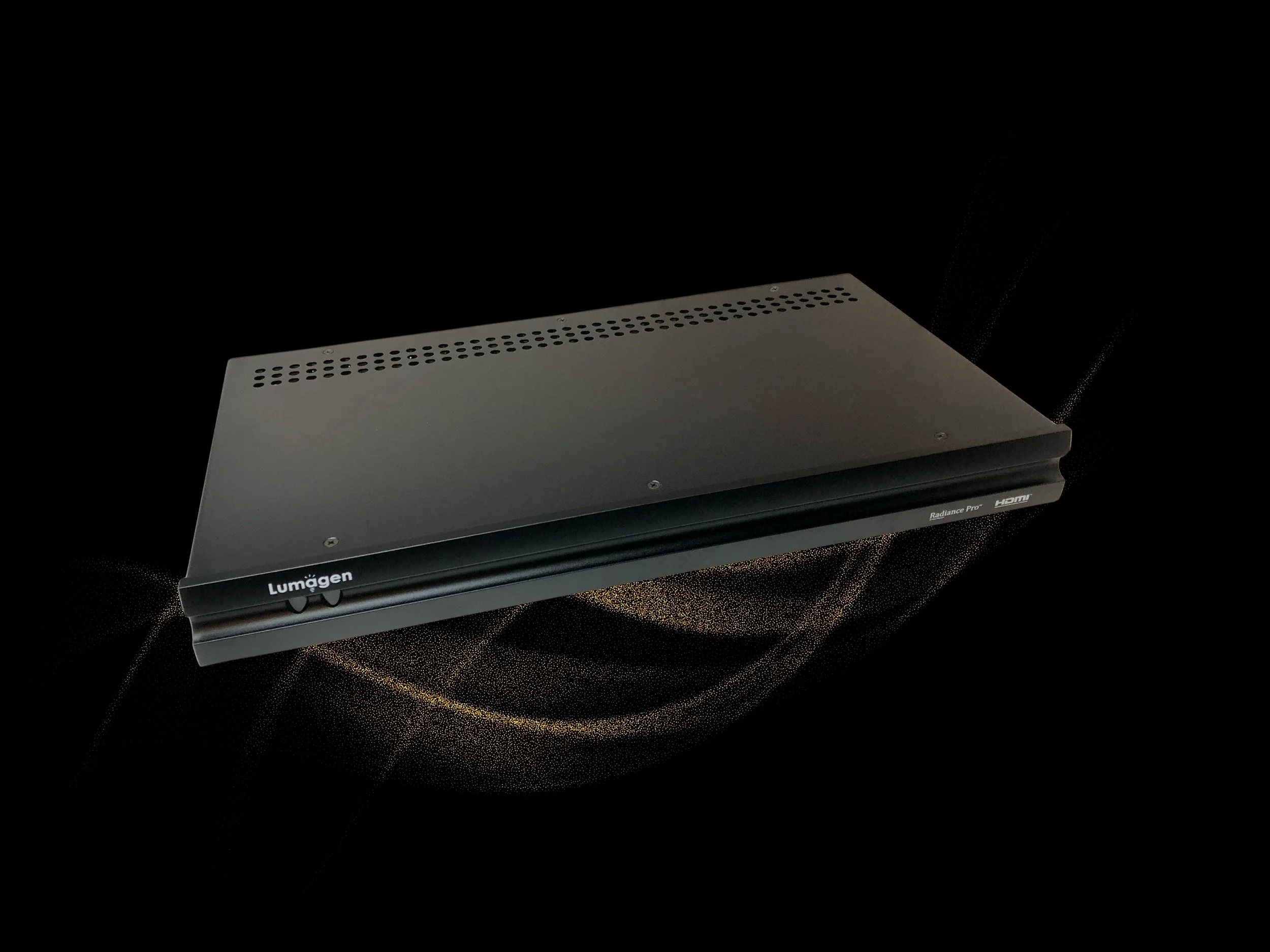
Radiance Pro sits between the source system and the display. It can manage HDR, scaling, frame timing, aspect ratio, output geometry, calibration and masking before the signal reaches the projector.
That matters because projector manufacturers have to design one processing system for many rooms. A dedicated external processor can instead be configured around one screen, one measured peak luminance, one calibration and one set of sources.
Dynamic tone mapping for a real projection screen
HDR10 can encode highlights far beyond the luminance of a projection screen. Radiance Pro analyses the signal and maps it into the actual dynamic range of the projector/screen combination. The useful question is therefore not whether the projector is "HDR compatible"; it is how intelligently the system compresses thousands of nits of source information into perhaps 100, 150 or 250 nits on screen.
Lumagen's DTM is mature and deliberately configurable. In a calibrated cinema the processor can be set around measured light output, so highlight detail, average picture level and shadow visibility are balanced for that room rather than left to a generic display mode.
NoRing scaling, deinterlacing and frame timing
Scaling is easy to underestimate on a large screen. Poor scaling can introduce ringing, edge halos, softness or unstable detail. Lumagen's proprietary NoRing scaling is intended to preserve detail without creating obvious sharpening artifacts. The processor also performs per-pixel SD/HD deinterlacing and can manage older sources that do not arrive as pristine 4K progressive video.
True Genlock is another less glamorous but important feature: each input frame can be output exactly once, helping keep motion and lip-sync behaviour predictable. A low-latency Game Mode is specified at roughly 3 ms of video delay while retaining processing.
Aspect ratio, anamorphic screens and physical masking
Radiance Pro is particularly strong in cinemas that do not use a simple 16:9 fixed screen. It supports anamorphic-screen workflows, programmable output aspect and image size, non-linear stretch and masking. That lets a 2.39:1 screen, a 2:1 screen or a masked 16:9 screen be treated as an intentional display format rather than a collection of manual presets.
Lumagen also publishes direct control support for Seymour Screen Excellence and Stewart Filmscreen masking systems. In a properly integrated room, content aspect ratio can therefore influence both the video geometry and the physical screen masking.
Calibration is one of the Radiance Pro's strongest reasons to exist
The processor provides a 4,913-point 17 x 17 x 17 3D LUT colour-management system and 21-point parametric grayscale calibration. This allows the complete video chain to be corrected with far more granularity than the basic colour controls in many projectors.
In high-gamut RGB-laser systems this can be particularly valuable. A projector can have an enormous native gamut and still require careful mapping to make Rec.709, P3 and BT.2020-container content track accurately.
Which Radiance Pro?
The processing philosophy is shared across the family; I/O configuration is the major practical difference. The 5xxx platform is also positioned for ultra-low output jitter and additional audio-path advantages.
When an external processor is worth it
If the projector already has strong DTM and the cinema uses a simple 16:9 screen with one or two good sources, an external processor may not be necessary. Radiance Pro earns its place when several requirements stack up: precise calibration, large screen, difficult HDR mapping, multiple aspect ratios, physical masking, anamorphic optics, older sources or a desire for one stable video-processing layer across future projector upgrades.
Lumagen Radiance Pro.
Current Radiance Pro product information and model configurations.
Decide on processing with the projector.
Send us the projector, screen ratio, masking strategy, sources and desired HDR workflow.